## What they do
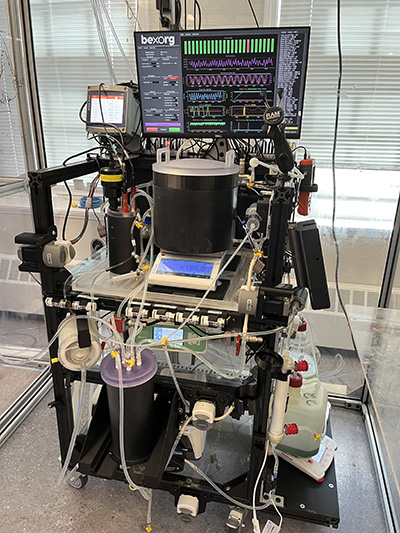
Bexorg ("Decode the Brain. Reinvent Drug Discovery.") restores molecular and metabolic activity in postmortem donated whole human brains using its BrainEx perfusion platform. It circulates an artificial blood-like fluid that keeps the tissue active for extended testing windows, without restoring consciousness or higher-level function. The approach descends from the Nature work (Sestan and Vrselja, Yale) that recovered cellular activity in pig brains hours after death.
The platform delivers any therapeutic modality, including small molecules, biologics, viral vectors and lipid nanoparticles, through the vasculature and across the blood-brain barrier, then reads out drug delivery, disease-model behaviour and pharmacokinetics. A "closed-loop" AI layer digests the resulting human-brain datasets to evaluate target engagement, discover biomarkers and predict pharmacokinetics.
## Why it matters
Around 95% of central nervous system clinical trials fail. The standard explanation is a translational gap: mouse neural architecture and in-vitro models do not predict the human brain. Bexorg's bet is to generate clinically predictive human data up front, before living-patient trials, bypassing animal models rather than improving them.
## Company facts
- Founders: Dr Zvonimir Vrselja (CEO) and Dr Nenad Sestan, spun out of roughly a decade of Sestan-lab research at Yale.
- Founded: 2021. Came out of stealth in October 2025.
- Location: Downtown New Haven, Connecticut.
- Team: around 30 (up from 5 three years earlier), including engineers, data scientists, bioinformaticians, machine-learning experts, physicians and drug-discovery specialists. Paul Wes (ex-Pfizer) leads drug discovery.
- Hardware: 5 operational BrainEx machines, with a 6th in build, targeting around 1,000 experiments per year.
- Funding: $42.5M in total, including a roughly $23M Series A in 2025. Investors named across coverage include Engine Ventures (lead), Amplify Partners, Starbloom Capital, Connecticut Innovations and E1 Ventures.
- Partnerships: Biohaven, which is testing two CNS candidates. Its CEO Vlad Coric said "BrainEx gave us the confidence to advance two CNS drug programmes, showing target engagement and brain exposure in human tissue, a true fast-forward for drug development." There is also a tie-up with the University of Oxford and the UK MRC on gene-therapy delivery.
## The uncomfortable part
The work sits in genuinely unsettled ethical territory, "not alive, but not dead", as Science framed it. Reactivating tissue in donated human brains, even without restoring awareness, demands continuous ethical oversight and consent through organ-donation networks. That ambiguity is also why the imagery, a brain suspended in a black perfusion container, has travelled so far on Reddit and in the more sensational "disembodied brains kept alive" coverage.
Sources: bexorg.com · Hartford Business Journal · longevity.technology · Science (AAAS) · Yale Ventures