Position Paper for W3C Workshop: Augmented Reality on the Web, Barcelona 2010 by Christopher Burman & Usman Haque.
Abstract
In this paper we make the case that future AR standards should focus on facilitating communications between disparate realities rather than defining how, when or where they are experienced and that standards should be designed expressly to encourage lateral approaches in reality design. In this context, we provide a brief overview of Pachube.com, a web service for storing and sharing sensor, energy and environmental data and the augmented reality application Porthole that helps people make sense of that data.
Introduction
The technology for generating augmented reality (AR) environments and our collective understanding of where it is headed have yet to settle - even partially. It is tempting to rely on an acronym and focus solely on the technological processes we are currently presented with to designate exactly what AR is – but this should be resisted. It is important that we focus on visions of multi-layered, complex universes spliced with our own and remember that to define augmented reality is to augment our definition of reality – a process we should continually probe. It would be a mistake to consider tech demos, and even successful applications in the current and near-future, as anything but placeholders of what AR as an extended thought experiment may become.
Applications providing contextually aware geo-located or spatially orientated information and imagery can be very useful but they are by no means the upper bounds. The aspects of such applications where standardization makes sense have more in common with existing or progressing standards – such as those for geo-location, points of interest and (semantic) data management. This is because, in our initial experience of ‘useful’ AR, we have used our location and especially our orientation as a control mechanism for the mobile web and the access of rich data-sets rather than to actually augment any realities.
The most important aspect of AR however is its capacity to fuse what we currently distinguish as ‘real’ and ‘virtual’ space – in AR, the distinction between ‘real’ and ‘virtual’ becomes as quaint as the 19th century distinction between ‘mind’ and ‘body’. The question is how to facilitate traffic – how to create the ‘plumbing’ – across those boundaries, precisely in order to erase them.
Putting aside the questions of human conscience that arise from a new-found ability to extend our existing perceptual world, there is scope for exercising creative forces that radically alter the way we function within our cities and around each other. The best approach to standardization – in a field where the range of possibilities (by default) extends beyond our current modes of thinking – is therefore to encourage new ones.
What steps do we take now to encourage creative thinking across platforms, cultures and communities? There may be a case for the creation of public infrastructure specifically to cultivate such experiments. Perhaps co-optable, physical tags for objects and buildings onto which new realities can be ‘hooked’? Perhaps these tags exist in the buildings around us already? Should we be designating specific areas of towns as being more suitable than others? Will we create zones in our houses and cities exclusively for AR?
AR ≠ Web
Trying to draw parallels between a browser based web and the possibilities of AR may solve issues of information distribution in the short-term but it must not have a limiting effect in the long-term. The key difference between the two is that even though we are familiar with the practices of navigating the web, we rarely gain satisfaction through interaction with a website alone. Indeed a good web interface is perhaps the one we notice the least.
Our experience of augmented realities could be tailored through standardization to provide the same rapid delivery of information and communication; reducing the occupancy of AR spaces to streamlined data views through suitable overlays and heads-up-displays (HUDs). This however, may deprive us of perhaps the fundamental excitement of the concept: the joy of participation through physical and sensory experience.
Rather than simply being told where to travel, an augmented reality could be the journey – a journey through a variety of sensory and perceptual experiences. We should not ask how to retool the web to extend it onto our streets but rather we should continue to solidify our expertise in the plumbing of human data networks and ask instead: how do we instrument our cities to facilitate new connected, augmented experiences?
Real-world AR applications and Porthole
In this section we explain the objectives and lessons derived from developing the Porthole AR application for Pachube.com, a web service developed and maintained by Connected Environments Ltd. Pachube is a platform that enables thousands of individuals and companies around the world to store, share & discover realtime sensor, energy and environment data from objects, devices & buildings – a platform for building the ‘Internet of Things’. We created Porthole as a consumer-oriented application that extends the universe of Pachube data into the context of AR – a ‘porthole’ into Pachube’s data environments.
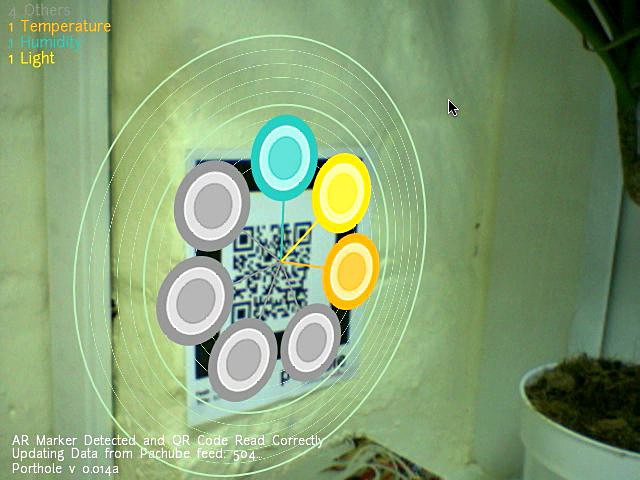
The application relies on the marker based ARToolkitPlus to orient 3D graphics around markers which are generated on the Porthole web page, printed and placed at points of interest. Inside each of these markers is a QR 2D bar code which - once the marker is discovered by the software – is decoded to enumerate the ID of the environment being queried.
Porthole automatically pulls both real-time and historical data relating to that environment from Pachube. Users can print markers that relate to the data feeds they have registered or those of others they are generally interested in tracking.
Thus the marker itself provides an interface to quickly correlate a real-world location with real-time values for temperature, or carbon-footprint, or any of the myriad of variables that can be tracked with Pachube at that location. The current version of the application allows users to see, at a glance, which types of data are available, the current values and standard deviations on closer interaction view graphs of historic data values.
This approach has advantages for creating networked objects connected to the internet, as part of the general category known as the ‘internet of things’. The interpretation and processing of sensor and environment data, alongside meta-data and historical comparison can be separated from the device. Rich data from objects or environments can then have local relevance despite being systematically separate from the device.
As the field of AR rapidly develops we are moving towards solutions that will not require markers to help construct augmented reality. Crucially, however it is precisely the physical presence of a marker that is so useful, acting as a human readable signifier of a potential AR experience.
It also provides a mechanism through which the same point of interest can provide a granularity of access to the data, granting different access permissions to different environmentally specific data. Porthole enables an AR experience to exist outside of an authentication infrastructure - allowing professional or private access to share the same infrastructure as public access, but receive differing levels of detail. In this way, a feed of valuable data containing detailed energy use of a building might not be made public – but its aggregate values might be.
As locations shift from being just sites of visualization to surfaces or dashboards for interaction this granularity becomes increasingly important to our potential experience of AR. If we invent the AR light bulb, who gets to see it and who gets to control the AR light switch?
[Download the original W3C position paper [PDF]](https://cb-todo-2025.s3.eu-west-2.amazonaws.com/writing/portholes_plumbing_w3c_2010.pdf)